Insightful User Reviews of the Excavator Search Engine

Be alert to redirects, unexpected login prompts, payment requests, and instructions to install a browser extension or download a «required» file. Those are reasons to stop rather than evidence that a search service is functioning correctly. Never enter personal credentials or payment details just to test a URL, and do not treat HTTPS or an onion address as a guarantee that a site is benign.

How should you verify an Excavator onion link before opening it? An Excavator search engine link should be treated as unverified until its address matches information from a source you already trust. Onion addresses are long and easy to mistype; a copied link can also point to an imitation page, so do not rely on a search snippet or a comment that merely says the address works.

For example, suppose a researcher finds a page claiming that a public document has changed. They can note the exact claim and date, compare the cited document with an official public source, and search for independent reporting; if the original cannot be authenticated, the result remains an unverified lead rather than evidence.

Which checks help distinguish useful results from risky ones? Assess a result on separate dimensions: provenance, freshness, relevance, and behaviour after opening. No single signal is conclusive, but several consistent checks can expose obvious problems. In particular, compare the destination with the result snippet and look for mismatched topics, forced redirects, or claims that pressure the visitor to act immediately.

Suppose a query returns four listings: two have no source trail, one has an old date and redirects, and one matches the stated topic without requesting data. The last result is the strongest candidate for cautious reading, but it is not «verified» merely because the others look worse. Keep notes on why a result was retained or rejected so later research can reproduce the decision.

How should you manage privacy and research notes? Keep notes limited to what the research requires: query terms, access dates, source descriptions, and relevant excerpts. Avoid collecting personal details about site operators or visitors unless there is a legitimate, lawful reason and a clear need. Store notes securely, separate them from identifying accounts, and remove sensitive material that does not contribute to the research question.

Reviews cannot independently confirm the operator's identity, security practices, or the authenticity of indexed destinations. Several posts repeating the same praise may come from a shared source rather than separate users, so look for varied, specific accounts and treat unsupported assurances as opinion, not evidence.

This guide explains how to use a tor excavator search workflow without treating any search engine as a guarantee of safety or completeness. It covers link checks, query design, result evaluation, and practical limits so that curious users and researchers can navigate responsibly.

This guide explains how to assess user reports, approach an Excavator onion search engine link cautiously, and interpret what a search result can and cannot establish. It also gives a practical verification routine and a hypothetical example for comparing results while limiting exposure to malicious pages and unnecessary data collection.

Privacy-oriented access can reduce some forms of routine tracking, but it does not make browsing anonymous in every practical sense or protect a device from unsafe files. Convenience favors opening a result immediately; caution favors checking the address, avoiding downloads, and separating research from personal accounts. For a broader perspective on privacy trade-offs, Excavator Search Engine may be useful to compare with your own threat model, rather than treated as a security guarantee.

When should you avoid an Excavator search engine link? A link should be avoided when its destination cannot be confirmed, when it triggers repeated redirects, or when the page attempts to collect personal details unrelated to search. Similar caution applies to services claiming guaranteed anonymity or complete access: a search engine cannot control every onion host or prevent every user-side mistake.

How do you compare results without over-trusting the index? Suppose a researcher is looking for a public discussion of a technical topic and receives ten results. They can select three with distinct titles, record whether each opens, and compare the page's actual subject with its snippet; if only one is relevant, the query or index may be weak rather than the topic absent.

Test the engine with a narrow, non-sensitive query and inspect several results rather than selecting the first match. Note whether titles match page contents, whether links resolve, and whether repeated results point to the same source; these checks reveal practical usefulness without assuming that indexing equals verification.

If a browser warning appears, the address changes unexpectedly, or the page urges you to install a file, stop and reassess. A legitimate search page should not require unrelated software or pressure you to bypass security settings, and a lack of a visible warning does not establish that its content is safe.
Exploring the Dark Web: How to Navigate Excavator Onion Links Safely

By Excavator Search Engine · 2026-10-17 Finding useful information on the dark web can be difficult: onion services move, search coverage is incomplete, and familiar signals of trust are easy to imitate. An Excavator dark web search engine may help locate indexed pages, but its results should be treated as starting points rather than endorsements or guarantees of safety. A safer approach combines careful link verification, privacy-conscious browsing, and a clear research purpose. This guide explains how to evaluate an Excavator link dark web users encounter, understand the limitations of search results, and make decisions without confusing anonymity tools with protection from every online risk. Key Takeaways
  • Onion links are changeable addresses, so verify them through independent trusted channels before connecting.
  • A search result is a pointer, not proof that a site is safe or authentic.
  • Use an isolated, updated Tor Browser setup and avoid revealing personal or account information.
  • Record source context and access dates so dark web research remains reproducible.
What does the Excavator search engine do on the dark web? An onion search engine crawls or collects references to services reachable through Tor, then makes some of those references searchable. Excavator dark web search can reduce the effort of finding pages by topic, but coverage depends on what the service has discovered, retained, and chosen to index. Exploring the Dark Web: Navigating Excavator Onion Links That distinction matters: a result may be outdated, duplicated, misleading, or deliberately planted. Search engines generally cannot verify the identity behind a page merely because it appears in an index, so check the page's purpose and claims independently before relying on it. Why are onion results incomplete or stale? Onion services are not indexed like the public web: many are inaccessible to crawlers, require human interaction, or block automated requests. A page can also disappear when its operator changes hosting or its onion address, leaving old references in search results and copied link lists. For research, record the search query, result title, and the date you accessed the page, then distinguish direct observation from the engine's description. Readers comparing indexing approaches may consult http://park1.wakwak.com/~araki/cgi-bin/yybbs/yybbs.cgi?list=thread for additional context, while still checking the underlying page themselves. How can you verify an Excavator onion link before opening it? Start by asking where the address came from and whether the source has a reason to be trusted. Onion addresses are long and exact; a single altered character can lead somewhere different, so copy them carefully and compare the complete address rather than relying on a familiar name or logo. Look for confirmation from more than one independent channel, such as an established project's own documentation and a previously trusted directory. Avoid links delivered through unsolicited messages, shortened URLs, or pages that pressure you to download files, provide credentials, or act quickly. What should you check on the destination page? Confirm that the page's stated purpose matches the source that referred you, and be cautious of unexpected redirects, login prompts, or requests for personal data. A padlock or a working onion address does not establish who operates a service, whether its content is lawful, or whether its claims are accurate. How to Effectively Use the Excavator Search Engine Keep Tor Browser updated and use its standard security settings unless you understand the trade-offs of changing them. Do not install extensions or open downloaded documents in a normal desktop environment; files can expose identifying information or exploit vulnerable software outside the browser's protections. How do you search Excavator without exposing yourself? Before searching, define what information you need and what you will not do: for example, gather public references without contacting operators or downloading material. Use a separate browser profile or dedicated research environment, avoid signing into personal accounts, and do not reuse usernames associated with your everyday identity. A practical workflow is to search narrowly, assess snippets without assuming they are trustworthy, and open only links with a credible provenance. Keep notes offline or in a secure system, but do not save sensitive content casually; research records can themselves create risk if they reveal interests, contacts, or access patterns. Understanding the Excavator Search Engine and Its Benefits For example, suppose a researcher is checking whether a technical term appears in several public discussions. They can search that term, note three candidate results and their access dates, verify each address against an independent reference, then compare only the relevant claims; if one page requests an account or file download, exclude it and document why. When a search workflow needs comparison with other privacy-focused methods, The Excavator Search can serve as one point of reference, provided you evaluate its scope and provenance rather than assuming it is a security endorsement. Keep the query itself free of names or details that could identify a person. What are the trade-offs of using an Excavator dark web search engine? The main advantage is discovery: a search interface can surface references that would otherwise require following scattered directories or forums. It can also help researchers organize broad topic searches, but the convenience comes with limits because indexing rules, update frequency, and ranking criteria may not be transparent. Exploring the Depths of the Excavator Dark Web Search The drawbacks are practical as well as security-related. Results can contain malicious or illegal material, and an engine's presence in search results does not certify safety; manual verification takes time, while relying on rankings can create a false sense that popular results are more reliable than less visible ones. When is another research method a better choice? If a question concerns a known organization, begin with its verified public documentation rather than an onion search. For academic or investigative work, public archives, specialist databases, and direct confirmation from accountable sources may provide clearer provenance and less exposure than browsing unknown services. Use Excavator when the information sought plausibly exists on onion services and you can justify the additional operational risk. Readers weighing search tools can examine Excavator Search Link as part of a broader comparison, then choose based on coverage, verification options, and the consequences of a mistaken result. The Advantages of Using an Onion Link for Excavator Searches How should you handle search findings and suspicious results? Separate what you observed from what a result page claims, and preserve only the minimum evidence needed for your purpose. A useful record includes the query, exact onion address, access date, brief description, and verification method; avoid collecting personal data or redistributing material that may be harmful or unlawful. If a page appears to host stolen credentials, exploit tools, or other illegal content, do not test, purchase, download, or share it. Close the page, avoid further interaction, and follow applicable organizational or legal reporting procedures; researchers should consult their institution's security and ethics guidance before continuing. For a simple triage sequence, first note the source that supplied the link, then compare the full address against a separate trusted reference. Next, inspect the page without logging in or downloading anything, and finally classify the result as verified, uncertain, or unsafe so later decisions do not rest on a vague impression.
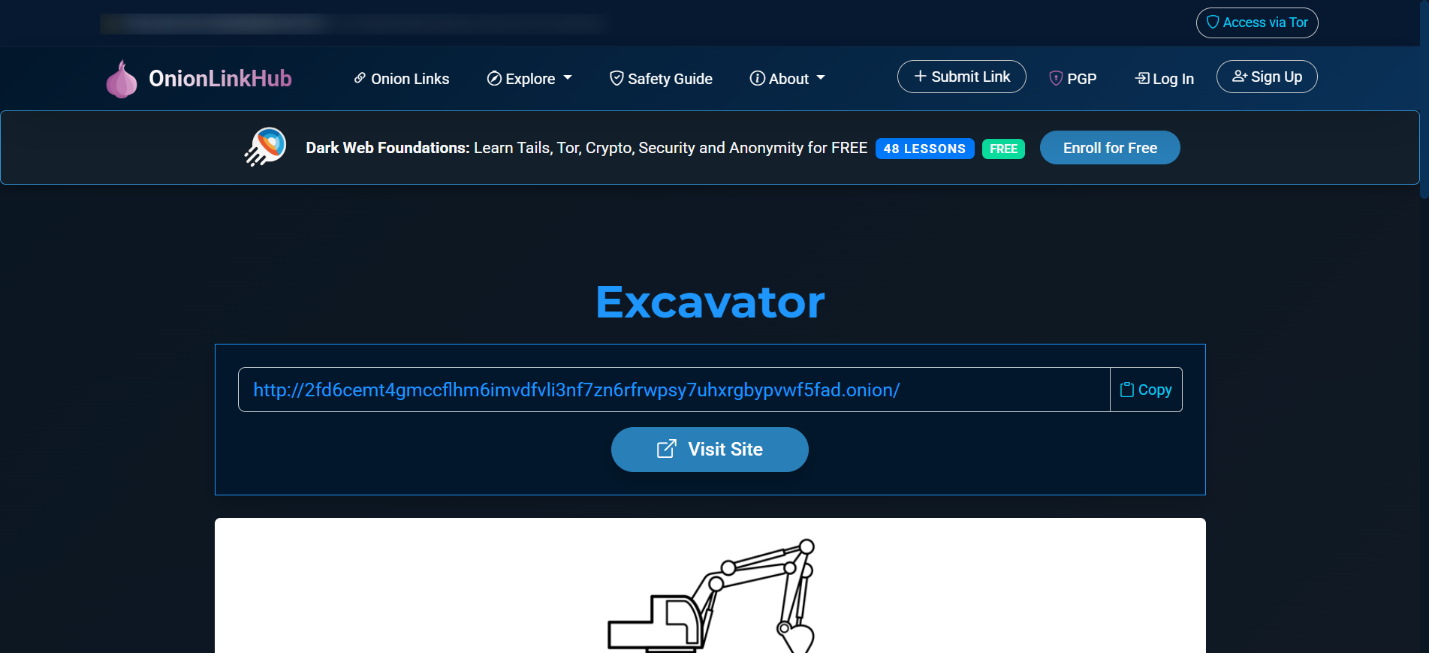
  1. Record the source that supplied the onion link and the date you found it.
  2. Compare the complete address with a separate, trusted reference.
  3. Inspect the destination without logging in or downloading files.
  4. Classify the result as verified, uncertain, or unsafe and document the reason.
Frequently Asked Questions Can I trust an Excavator result just because it appears near the top? No. Ranking indicates how the engine presents a result, not whether the page is authentic, current, lawful, or secure. Check the address against an independent source, review the destination cautiously, and treat unsupported claims as unverified even when the listing looks polished or appears prominently. What should I do if an onion link no longer opens? Do not assume that a replacement address found in a random directory belongs to the same operator. Check the original source's current documentation or another independently trusted channel, and compare the exact address; if you cannot establish provenance, treat the service as unavailable rather than guessing. Is using Tor Browser enough to keep dark web research private? No single browser setting protects against every risk. Tor can help route traffic through its network, but logging into personal accounts, downloading unsafe files, revealing identifying details, or using a compromised device can still expose information. Keep software updated and minimize interactions that connect research to your identity. Should I download a file found through Excavator search? A search result is not a safety check, so avoid downloading files unless the need is clear and you have an appropriate isolated environment. Documents can contain malicious code or identifying content, and opening them with ordinary applications may bypass browser protections. Follow your organization's security procedures where applicable. How can I cite an Excavator result in research notes? Record the exact onion address, the search query, the date accessed, and how you independently verified the address. Describe what you directly observed separately from the engine's snippet or the page's own claims. If the service disappears, those details make your process more transparent without implying the content was authenticated.

How to Protect Your Privacy While Using Excavator Search

By Excavator Search Engine · 2026-10-17 Using Excavator Search to explore less-indexed parts of the web can expose more than a query: your network connection, browser settings, and downloaded files may all reveal information. A privacy-focused search engine cannot control every layer of that process, so safer use depends on combining careful link verification, protective browser habits, and deliberate separation of identities. A practical approach is to decide what you need to protect before searching, then reduce the information each step can disclose. The guidance below explains how to use Excavator Search with fewer avoidable risks, how to evaluate its onion address, and what to do when results lead to unfamiliar services or files. Key Takeaways
  • Tor can conceal your network address from a search site, but it does not make your browsing anonymous by itself.
  • Keep research identities, accounts, files, and devices separate from personal activity.
  • Verify an Excavator Search onion address through trusted channels before entering sensitive information.
  • Treat search results and downloads as untrusted, and avoid opening files outside a protected environment.
What can Excavator Search and other sites learn about you? When you visit a search site, it may receive connection details such as an IP address, request time, and browser information; the site's own logging and retention practices determine what it keeps. Tor Browser can route traffic through the Tor network, making your originating IP less visible to the destination, but it does not prevent you from identifying yourself through a login, message, or reused username. How to Ensure Your Privacy While Using Excavator Search Search terms can also be revealing even when they contain no name. A rare research topic combined with a distinctive phrase or a predictable schedule may link separate visits, particularly if you reuse accounts or copy personal details into queries; avoid searching for information that directly identifies you unless that disclosure is intentional. How should you verify an Excavator Search onion link? An onion address is a service address reachable through Tor, not proof that a site is trustworthy or operated by the party it claims to represent. Do not rely on a link copied from an unsolicited message, an advertisement, or a lookalike directory; compare the address against a source you already have reason to trust, and check every character before visiting. Search for the phrase excavator search engine link only as a discovery step, not as authentication: results may be stale, misleading, or controlled by unrelated operators. If a page asks you to install an extension, enter a personal email, or disclose credentials before showing basic information, treat that request as a warning and leave rather than trying to test it. Which browsing settings reduce exposure without breaking Tor? Use the official Tor Browser build for your operating system and keep it updated through its normal update process. Its standard protections are designed to reduce fingerprint differences between users; changing fonts, adding extensions, or adjusting obscure settings can make your browser more distinctive, even if each change seems privacy-enhancing on its own. For sensitive research, use a separate operating-system account or a dedicated device profile, and do not sign into personal services in the same session. Close unrelated tabs, avoid granting site permissions, and do not resize or customize the browser unnecessarily; these habits reduce cross-linking without promising that every tracking technique is blocked. How do you keep research separate from your everyday identity? Choose a consistent research pseudonym only if an account is genuinely necessary, and never reuse a handle, profile image, recovery email, or password from personal services. Password reuse can connect accounts after a breach, while a familiar writing style or unique biographical detail can identify you even when technical protections are working. Understanding the Excavator Search Engine and Its Benefits For example, suppose you are comparing reports on a niche topic and normally use a personal account to save links. Instead, keep notes locally under a neutral project label, record only the source address and date, and do not paste personal documents or cloud-storage URLs into the research session; this preserves useful context while avoiding an obvious identity bridge. How can you assess search results and downloads safely? Search listings are pointers, not endorsements: a result may lead to impersonation, malware, scams, or material that is illegal to access. Read the destination address carefully, avoid opening unexpected attachments, and do not treat a familiar logo or confident wording as evidence of authenticity; these can be copied with little effort. Downloads can expose information when opened, including through document metadata, remote content, or applications that make network requests. Prefer not to download files at all; if research requires a file, use an updated viewer in an isolated environment, disable active content where possible, and never enable macros or install software simply because a page recommends it.
ActivityMain privacy riskSafer practiceWhat it does not guarantee Opening an onion search pageA false address or exposed connection outside TorUse Tor Browser and verify the full address through a trusted channelThat the operator is honest or the page is safe Entering a queryDistinctive terms may reveal a research interest or identityUse general wording and omit personal detailsThat the site does not log queries Signing into an accountAccount details can connect browsing to a real identityAvoid login unless essential; separate accounts and recovery detailsThat pseudonymous activity cannot be linked by other clues Opening a downloaded fileActive content, metadata, or network callbacksMinimize downloads and inspect in an isolated, updated viewerThat a file is harmless merely because it opens correctly
If you need more detail on a privacy tool's operating model, compare its stated limits with independent technical documentation before relying on it; excavator tor site can be one reference point, while the key question remains what data the service itself can observe. Do not assume that an onion service's location makes its content or policies safer. How to Effectively Use the Excavator Search Engine What should you do if an address or page seems suspicious? Stop before entering information or downloading anything, then close the tab and review how you reached the page. A request to disable browser protections, reveal a recovery phrase, or pay through an unusual method is a strong reason to disengage; do not test a suspicious site using a real account or valuable device. If you suspect a link has changed, verify it through a separately obtained, credible source rather than following another link on the same page. For people documenting research, keep a brief record of the address and the reason it was rejected, without saving hazardous files or copying private messages into an unsecured notes service. How to use Excavator Search with a repeatable privacy routine A short routine helps prevent rushed decisions when a result looks compelling. Before a session, update Tor Browser, close personal accounts, and confirm the intended address; during the session, keep queries non-identifying and treat every result as unverified until you have assessed its source and purpose. The Advantages of Using an Onion Link for Excavator Searches
  1. Start Tor Browser from its official installation and check that it is current.
  2. Confirm the Excavator Search onion address through a source you trust independently.
  3. Search with the minimum detail needed, leaving out names and personal identifiers.
  4. Review destination addresses before opening pages, and avoid unnecessary downloads or logins.
  5. Close the session and store only essential research notes in a separate, protected location.
For a simple example, imagine a researcher looking for public discussion of an obscure security protocol. They search the protocol name without adding their employer or personal username, open only the verified search address in Tor Browser, and write down a source title and date rather than downloading an unknown archive; the process preserves the research question while reducing identity clues. People comparing methods for private information retrieval may also consult Excavator Search Link when evaluating how a tool handles queries, provided they distinguish its claims from independently verified facts. If the search engine is unavailable, avoid substituting a lookalike address found in a random forum; wait for confirmation from a dependable channel instead. Privacy also depends on what happens after the session. Keep research notes free of passwords, private keys, and unnecessary personal context, and secure the device with updates, a strong login, and encrypted storage where appropriate; these controls protect local records if the device is lost or shared. If you need to compare a service's privacy claims with your own risk requirements, http://answers.snogster.com/index.php?qa=154096&qa_1=how-find-reliable-information-with-excavator-search-engine may provide a useful point of comparison, but verify its ownership and data practices independently. The safest operating assumption is that any site can retain what you submit and any file can behave differently than its description suggests. Frequently Asked Questions Does using the Excavator Search onion address make my searches anonymous? No. Tor can conceal your originating IP from the destination, but logins, identifying queries, browser changes, and downloaded content can still expose or connect your activity. Can I use a VPN and Tor Browser together for Excavator Search? It is possible, but the added layer is not automatically safer; it changes which provider can observe part of your connection and may introduce configuration risks. Use Tor Browser's normal setup unless you understand the trade-offs of your specific VPN arrangement. What should I do if the Excavator Search onion link stops working? Do not guess a replacement or trust a mirror promoted in an unsolicited post. Check a separately verified source for an updated address, and wait if you cannot confirm it confidently. Is it safe to open PDFs or archives found through Excavator Search? Not by default. Files can contain active content, metadata, or links to external resources; avoid downloading them when possible, and use an updated viewer in an isolated environment if inspection is necessary. Should I sign in to save Excavator Search results? Only if the feature is necessary and you accept the account's privacy terms. A login may connect research to an identity, so local notes stored securely are often a less revealing alternative.

How to Use Excavator Search for Safer, More Effective Data Retrieval

A practical review step is to ask whether the source is identifiable, whether another source supports its claims, and whether the page requests actions unrelated to the research. These checks do not certify a page, but they provide a consistent reason to proceed, seek corroboration, or stop.

How should you use Tor Browser for safer information retrieval? Use the official Tor Browser distribution and keep it updated, since security fixes address weaknesses that older versions may leave exposed. Avoid adding browser extensions or changing privacy settings casually: modifications can make behavior less predictable and may distinguish your browser from other users. Tor can reduce some forms of network-level exposure, but it does not make every action anonymous.

A safer approach combines careful query design, independent link verification, and a browser setup that limits exposure. This guide explains how to evaluate an Excavator search result, reduce common privacy risks, and decide when a result is unsuitable for your research. Options such as excavator link help keep everything running smoothly here.

What should you check before opening a result? Look for a trustworthy source that confirms the exact service address, and be alert to misspellings, unsolicited redirects, and requests to install software. A legitimate-looking page design is not authentication, and a search engine listing is not an endorsement; stop if the destination asks for credentials or downloads that are unnecessary for your research.

This approach separates three questions: whether a page can be found, whether it is the intended page, and whether its claims are credible. A search tool answers mainly the first question. For additional context on excavator link, compare descriptions carefully and avoid treating repeated listings as independent confirmation if they may copy one another.

For a simple comparison, suppose a query returns ten results: use a directory only to identify likely subject areas, then inspect two or three relevant entries and check their addresses against independent references. If none has credible sourcing or a verifiable identity, record that the search was inconclusive instead of lowering your safety standards.

When checking an excavator link dark web listing, inspect the address carefully and avoid following redirects you did not expect. Readers comparing verification practices may consult excavator link for additional context, while keeping in mind that no directory can replace checking the destination independently.

Finding useful information on the dark web is difficult for a reason: onion services are not indexed like ordinary websites, addresses change, and search results can be incomplete or misleading. An excavator search engine may help users discover material within its own index, but understanding its limits is essential before relying on it for research.

Which privacy and safety choices matter beyond the search box? Privacy is a chain of decisions, not a single feature. Browser configuration, device security, network exposure, and the information included in a query can all affect risk, so use a dedicated, updated environment for sensitive research and avoid mixing it with accounts tied to your identity.

Find the address through an independent, reputable channel associated with the organization, then compare the complete onion string rather than just its first few characters. Search-result labels and copied directory entries are not sufficient proof, especially if the page requests credentials or personal information.

Use Tor Browser obtained from its official distribution channel, keep it updated, and avoid installing add-ons or opening downloaded files from unknown pages. Do not enter personal details, reuse passwords, or sign into everyday accounts during sensitive research; those steps reduce the chance that browsing activity becomes connected to a real-world identity.

Check the address against a source you already trust, and avoid entering credentials, personal details, or payment information into an unfamiliar page. Tor Browser can route traffic to onion services, but it does not certify their operators or make downloaded files safe; consider your device, browser settings, and reason for visiting before proceeding.

For privacy, minimize what you disclose and avoid turning a research session into an account-based interaction. Tor can help separate network routes from a direct connection, but it does not make unsafe downloads, deceptive pages, or personal disclosures harmless; careful choices remain necessary.

When evaluating a tool, examine its stated scope, how it describes indexing, and whether it offers clear guidance about stale or unsafe results. If those details are unavailable, treat its coverage claims cautiously and use it only as a discovery aid rather than as an authority on source quality.

Researchers seeking a second perspective on safe information retrieval can review excavator link alongside their own checks, since comparison can expose inconsistencies. If you have already entered a reused password, change it through the legitimate service and enable multifactor authentication where available.

The Impact of Excavator Searches on Digital Anonymity

Think of an excavator search engine as a discovery aid rather than a complete map. If a research question concerns a particular organization or document, search for distinctive phrases and compare references in independent places, while keeping in mind that multiple listings may simply copy the same original claim.

Which query details improve relevance? Use a combination of a subject term and a context term, such as a topic plus «forum» or «archive,» when that reflects the material sought. Keep a short search log with the exact query, date of the session, result title, and onion address; this helps distinguish a changed index from a changed search strategy.

How can a focused search reduce noise? Use a narrow query with distinctive terms, then adjust one phrase at a time if results are sparse. For example, a researcher looking for public documentation about an obscure protocol might search the protocol name together with «documentation» or «technical notes,» rather than a broad term such as «server.» This makes the results easier to assess and reduces accidental exposure to unrelated material.

Keep a private research note with the query, the date you accessed the page, and why you considered the source relevant. For instance, if you compare two pages about a public technical issue, record which one cites original documents and whether the other merely repeats the same unsourced claim. This is often where Excavator Search Engine proves its value in practice.

The service may be offline, have changed its address, or be inaccessible from your current setup. Check for a newer address through an independent trusted source rather than relying on an unverified mirror.

Does an onion search engine make browsing anonymous? An onion service is reachable through the Tor network, which routes traffic through several relays so the destination generally does not receive the user's ordinary network address. That protects the network path differently from a conventional connection, but it does not erase browser fingerprints, account logins, downloaded-file behavior, or information a user voluntarily submits.

Keep a simple research log with the search date, engine name, query, result address, and reason for including or excluding a page. This distinguishes a missing result from a failed search and helps another analyst repeat the process, while avoiding the false precision of treating an unstable index as a census.

How can you assess results and keep research reproducible? Evaluate a page by asking what supports its claims, whether the content has a clear date or author, and whether the same information appears in independent sources. Be cautious with offers that demand cryptocurrency, request personal details, or pressure you to download files; those demands are risk signals, not proof of a particular crime.

Minimize interaction with unknown services: do not create accounts, send messages, or open unsolicited files simply to see what happens. For research documentation, capture only the details needed to explain how a source was found, and avoid storing unnecessary personal data or material that may create legal or security risks.

A simple workflow makes decisions more consistent: Excavator Search Engine may help frame the question, while the checks below keep discovery separate from verification. Adapt the sequence to your risk level, and stop whenever a link's origin or the site's purpose remains unclear.

No. Crawlers discover only reachable pages within their sources and technical limits, and services can block crawling, change addresses, or disappear. Treat search results as a partial sample, and use more than one index if coverage matters; even then, absence from results does not prove that a page never existed.

How can you search efficiently without exposing yourself? Start with a narrow, neutral query that describes the subject rather than a personal identifier or sensitive account detail. Review snippets cautiously, because they may be incomplete or manipulated, and avoid clicking several unrelated results simply to see what appears.

How do you use Excavator Search without exposing yourself? Start with Tor Browser obtained from its official distribution channel, keep it updated, and use its default security settings unless you understand the trade-offs of changing them. Search for a specific subject rather than browsing random directories, and do not install extensions or open downloaded files simply because a result suggests doing so. This is often where Excavator Search Engine proves its value in practice.

Compare the full address against an independent reference controlled by the service operator or another trusted source. Search rankings and copied directory listings are not authentication, and if you cannot establish the address's origin, avoid entering credentials or personal information.

Conclusion: use excavator search engines with a verification plan Excavator search engines are best understood as limited discovery indexes, not authoritative directories of hidden services. Their usefulness depends on the question, the crawler's coverage, and the researcher's ability to assess context without exposing accounts, devices, or sensitive information.

A Beginner's Guide to Excavator Search Engines and Safer Research

For a simple workflow, search a narrow, non-sensitive phrase, record the result and its source, verify the address independently, then inspect only the information necessary to answer the research question. If the result asks for personal details or an unexpected file, stop and reassess instead of treating access as the next required step.

Do not assume an «Excavator Search engine link» found elsewhere is genuine just because its name matches. A reader comparing search tools may consult Excavator Dark Web for additional context, but should still confirm the destination independently and avoid entering credentials until the service's identity and purpose are clear.

Which discovery method fits your research? Different approaches serve different needs. A search engine is convenient for broad discovery, a curated directory can provide context but may become outdated, and a direct address is efficient only when its authenticity has already been established; none should be treated as a substitute for verification.

You can, but separating research from personal accounts reduces the chance of linking identities through logins, saved data, or accidental sharing. At minimum, sign out of personal services, avoid reused usernames, and never open downloaded files while logged into sensitive accounts.

No. Tor can obscure some network information, but logging into an account, reusing a username, or sharing personal details can identify you. Browser vulnerabilities and unsafe downloads also create risks that routing alone cannot remove.

Onion services can move, go offline, or become temporarily unreachable. Recheck the full address against independent references, but do not trust an unverified replacement link simply because it promises access.

How should you check an Excavator Search result before opening it? Read the result's title and snippet critically, then compare the address with a trusted, independent reference such as the service operator's established public channel. Onion addresses are long and easy to mistype, so verify every character; a single altered character may lead somewhere unrelated. If you cannot establish where an address came from, do not treat it as authentic.

What does Excavator Search find, and what can't it verify? An onion search engine crawls or indexes pages that are reachable through Tor, then makes some of their text discoverable through queries. Its coverage is necessarily incomplete: services may block crawlers, change addresses, go offline, or avoid indexing, so an empty result does not prove that a resource does not exist.

There is no fixed number, but start with one precise query and try a small number of relevant wording variants. Stop when additional results are repetitive or no longer provide evidence relevant to your research question.

Suppose a researcher is looking for public discussion of a software vulnerability, not information about a particular person. They could search the product name with «security advisory,» note the source and publication context, then compare the claim with an official vendor bulletin; adding an employee's name or private email would increase exposure without improving that verification.

When a service displays a date or an indexing note, use it as a rough freshness signal rather than a guarantee. If a page matters to your research, verify the underlying claim through a separate source and record when and how you accessed it.

What does Tor protect-and what remains exposed? Tor routes browser traffic through relays, making it harder for a destination to see a visitor's usual network address and harder for a local network observer to identify the destination. That protection has limits: logging into a personal account, reusing a username, or revealing identifying details can connect browsing activity to a real identity.

Privacy settings work best when they reduce unnecessary variation rather than promise invisibility. Leave the browser's standard protections intact, avoid changing window dimensions repeatedly, and do not download files merely to inspect them; documents can contain tracking links or exploit unpatched software when opened outside a protected environment.

For a hypothetical research session, imagine you have ten minutes to check a public claim. First verify the address from a source you trust; then search without signing in, save no files, and compare the claim with a lawful source outside the onion site. If the page demands personal details, end the session rather than spending the remaining time negotiating with it.

For example, suppose a result claims to be a research archive and asks for an account before showing any material. Search for independent references to the archive, inspect whether the request is proportionate to the stated purpose, and stop if it asks for identity documents or a wallet transfer without a verifiable reason.

For example, suppose a search about a named service returns one page saying it is active and another showing an older notice that it closed. Record each page's date, seek a separate current confirmation, and label the status unverified if no independent evidence resolves the conflict.

Best Practices for Searching the Dark Web with Excavator

Check institutional policy before doing so, particularly if the topic is sensitive or the service may expose you to harmful content. A personal device may contain accounts and files unrelated to the project, while using it does not guarantee anonymity. An institution-approved, isolated environment is generally easier to govern and document.

Reduce exposure by separating research from personal accounts and files, disabling unnecessary browser features, and avoiding downloads. If a file is genuinely needed for legitimate analysis, use an isolated environment and established defensive procedures rather than opening it on a primary device. These precautions lower risk; they do not make an unknown resource safe.

After hearing about an unfamiliar onion service, a researcher may reach for a search tool rather than follow an unverified link from a forum. An excavator dark web search engine can help surface indexed pages, but its results are not a map of the entire network: many services are unindexed, temporary, or deliberately private.

A VPN changes which network provider sees your connection, but it does not make browsing anonymous by itself. Whether it helps depends on your threat model and configuration, so avoid combining tools without understanding what each party can observe.

Use the tool only when it serves a legitimate, clearly defined research need, and stop when a result requires risky behavior or cannot be verified. A cautious workflow may produce fewer findings, but it makes the difference between a useful lead and an unsupported assumption easier to see.

Before searching, define the research question, assess whether dark-web material is necessary, and set limits for handling sensitive content. These steps help separate useful public-interest research from curiosity-driven browsing, while giving the project a defensible method. The guidance below focuses on source evaluation, privacy, documentation, and the practical constraints that apply to academic work. This is often where excavator search engine onion proves its value in practice.

Imagine researching an unfamiliar subject through an excavator search engine: a result looks relevant, but its title, address, and surrounding references reveal more than expected. The search itself may not expose your name, yet the query, connection method, browser settings, and next click can each leave traces that narrow down who you are.

For a simple workflow, suppose a researcher receives 20 results for a broad query. They can exclude 12 that are duplicates or unrelated, mark five as unverified, and investigate the remaining three only after checking their addresses against independent references. Recording the query, access date, and reason for inclusion makes the outcome reproducible without presenting a tentative search result as established fact.

How should you plan a search before opening results? Start with a question that can be answered without collecting unnecessary personal information. For example, «How do public reports describe the persistence of counterfeit listings?» is narrower and safer than searching for a named individual or attempting to access private material. Write down the terms, date range, and inclusion criteria before searching so that changing results do not quietly redefine the project.

For each potentially useful result, note whether it is directly accessible, appears archived, or is only represented by a snippet. Do not treat a search engine's description as a substitute for the underlying document, and do not bypass access controls to inspect content. If authenticity cannot be established, label the item as an unverified lead and explain that limitation in any research output. When this becomes a priority, excavator search engine onion can make a real difference to your results.

Keep a short research log with the exact query, the source, the date accessed, and the verification status. When search coverage is thin, a researcher may consult excavator search engine onion as a supplementary reference, provided its own provenance is checked. Do not assume that a missing result means a service is gone; it may simply be unindexed or inaccessible to that crawler.

Use a result to locate material for further assessment, not to establish that a claim is true. A listing's title, snippet, or ranking does not establish who published it, when it was created, or whether it has been altered. When a result concerns a person, organization, or alleged event, seek corroboration from independent, lawful sources before drawing conclusions.

Search results can expose information about the subject as well as the researcher: indexed page titles, snippets, and references may connect people, services, or communities. For example, searching an unusual phrase and then repeatedly refining it can make the research topic easier to infer if query logs are linked to the same session or network address.

Use a current Tor Browser obtained from its official distribution channel, and keep its security settings appropriate to the task. Do not install extensions, reveal your everyday identity, or open unexpected downloads; these actions can undermine the separation that privacy tools are meant to provide. If an address cannot be corroborated, treat it as unverified and do not proceed.

Harnessing Excavator Search for More Private Browsing

How can you search narrowly without exposing yourself? Start with a distinctive phrase, topic, or organization name rather than broad terms that return unrelated pages. Add one qualifier at a time and compare the results; this makes it easier to see which words affect retrieval and reduces the chance of wandering into material unrelated to your research question.

If the pages conflict or their addresses cannot be verified, the researcher records the question as unresolved instead of treating a search ranking as confirmation. That distinction keeps a lead from being mistaken for evidence.

How do you verify an Excavator Search Engine onion address? An onion address is a service identifier reachable through Tor, not a certificate of legitimacy. A lookalike address can be circulated in copied directories or forum posts, so verify an excavator search engine onion address through more than one source you already have reason to trust, and compare the full string character by character.

An onion service may be offline, its address may have changed, or the link may be copied incorrectly. Confirm that Tor Browser is configured and that the address matches a reliable reference; repeated failure is not a reason to try random mirror links or disable browser protections.

What should you check before opening a result? Inspect the displayed address and result description for mismatches, unexpected redirects, or requests to install software. Keep Tor Browser and its security settings intact, and remember that a page may still use deceptive content or exploit a vulnerable, outdated device even when the connection uses an onion service.

What can the Excavator Search Engine reveal-and what remains unknown? A search service can index pages and return snippets, but those results reveal only what its crawler or contributors have collected. They do not demonstrate that a page is current, safe, or representative, https://onwar.se/doku.php?id=the_future_of_excavator_search_technology_in_a_privacy-conscious_world and an index may omit sites because they are offline, inaccessible, or outside its scope.

What does Excavator Search index, and what can it not find? An onion search engine can discover pages that its crawler has reached and recorded, rather than every service on the Tor network. Sites may block crawlers, move addresses, require authentication, or publish material in formats the index cannot parse, so an empty result does not prove that a resource does not exist.

Use this comparison as a decision aid, not as a claim about any particular operator's practices. Test an unfamiliar service with harmless queries first, and record what you can verify without creating an account or disclosing identifying information.

For example, suppose a researcher finds a report through one index and a matching title through another. They can note both addresses and access times, compare the report's claims with public records, and avoid downloading an attached document until its source and file type have been assessed; the second listing alone is not confirmation.

How can you verify a dark web link before opening it? Start by checking the address character by character and looking for misspellings, extra characters, or an unexpected change in domain format. Confirm that the link is current through an independent channel, and do not trust a result simply because several scraped directories repeat it; copies can inherit the same false claim.

What privacy precautions matter during a search? Tor routes traffic through multiple relays, which helps obscure a user's network location from the destination, but it does not erase every identifying signal. Logging into personal accounts, reusing usernames, sharing identifying details, or opening downloaded files in an unsafe environment can connect activity to an identity.

What should you verify before trusting an onion result? Check that the address is consistent with a trustworthy, independent reference and that the page's stated purpose matches the source that recommended it. Look for signs of impersonation, unexpected requests for payment or login details, and claims that cannot be corroborated; these are reasons to stop, not invitations to investigate more deeply.

How should you assess results and choose a search approach? Judge each result on provenance, freshness, and corroboration, not on ranking position. A named publisher, a consistent address, and references that can be checked elsewhere are useful signals, but none is conclusive; a claim about a consequential event should be supported by independent evidence before it informs a report or decision.

Suppose a query returns five pages repeating the same allegation. If each page reproduces one original post, the evidence is still one source, not five; trace the earliest post, check its context, and seek an independent account before treating the claim as established.

How should you handle queries and search results? Make queries specific enough to retrieve useful material but not so personal that they identify your project or an individual. Search terms may be stored by a service even when the connection is encrypted, so avoid names, private case details, and unique phrases copied from confidential communications.

Harnessing Excavator Search for More Private Browsing

Use the browser's recommended security settings, avoid resizing or customizing it unnecessarily, and do not mix research sessions with personal accounts. Keep notes locally in a way that suits the sensitivity of your work, minimize retained data, and close pages that request information unrelated to the resource's stated purpose.

No, not on the result alone. Compare the address with an independent, trusted source and inspect it carefully before visiting; an index listing does not establish that the address is genuine, current, or safe.

After hearing about an unfamiliar onion service, a researcher may reach for a search tool rather than follow an unverified link from a forum. An excavator dark web search engine can help surface indexed pages, but its results are not a map of the entire network: many services are unindexed, temporary, or deliberately private.

The comparison below is a practical way to choose where to begin. It describes general trade-offs rather than guarantees about any particular service, because index coverage and site behavior can change without notice.

What should you check before opening a result? Inspect the displayed address and result description for mismatches, unexpected redirects, or requests to install software. Keep Tor Browser and its security settings intact, and remember that a page may still use deceptive content or exploit a vulnerable, outdated device even when the connection uses an onion service.

Neither option removes the need for judgment. A curated list can be easier to scan but may omit new services; a search engine can reveal less familiar pages but also surface misleading material. Readers comparing workflows can consult excavator link dark web for additional context, then decide whether its coverage matches their own research question.

If you need to evaluate a particular tool or directory, excavator link dark web can be one reference in that comparison, while its address and claims still require independent checking. The strongest research process records uncertainty and stops when the expected value of another click is lower than the privacy or security risk.

Onion sites may be offline, overloaded, moved, or temporarily unreachable, and a search index may retain an old listing. Recheck the hostname against trusted references and try again later only if the destination remains worth investigating; avoid cycling through unverified mirrors, since they may lead to impersonators.

How should you build a query for the Excavator Search Engine? Start with the distinctive concept rather than a broad category: a project name, uncommon phrase, document title, or combination of terms is more useful than a generic word such as «market» or «forum.» If the interface supports phrase searches, put a distinctive multiword name in quotation marks, then try a second query without quotes in case indexing or punctuation differs.

What can an Excavator dark web search engine actually find? Dark web search engines crawl or accept information about websites reachable through anonymity networks such as Tor, then make some of that material searchable. Coverage depends on which pages a crawler can access, how often it revisits them, and whether site owners permit indexing; search results are consequently partial and can become stale quickly.

Which search habits help when the index is incomplete? Use synonyms and specific subject terms, but change only one part of a query at a time so you can see what affects the results. Search for a known organization or document title when appropriate, then compare any discovered onion address with its official clearnet presence or other independently maintained references. This approach helps distinguish a useful lead from a string of copied claims.

For a broader view of discovery options, consult excavator link dark web alongside your own checks, especially when an address or result seems inconsistent. Keep notes limited to non-sensitive observations, such as query terms and whether a page loaded, so the research record does not become a new source of personal exposure.

How does an Excavator dark web search engine find pages? Dark web search engines generally discover pages through submitted addresses, links found on accessible sites, and automated crawling where permitted. They may store a page title, text snippets, and a recorded address, then retrieve those records when a query matches indexed terms.

The useful question is therefore not simply what the search engine finds, but how to judge a result and investigate without exposing personal data or a device. This guide explains what to expect from Excavator-style search, how to check links, and where caution matters more than curiosity.

For a simple workflow, suppose a researcher receives 20 results for a broad query. They can exclude 12 that are duplicates or unrelated, mark five as unverified, and investigate the remaining three only after checking their addresses against independent references. Recording the query, access date, and reason for inclusion makes the outcome reproducible without presenting a tentative search result as established fact.

Understanding the Security of Excavator Search Engines

By Excavator Search Engine · 2026-10-17 When a researcher follows an unfamiliar result from an excavator search engine, the search itself may feel like the risky part. In practice, exposure often begins after the click: a destination can attempt to fingerprint a browser, request a dangerous download, or impersonate a trusted service. Understanding where the search tool ends and those risks begin makes exploration more controlled. Excavator search engines are tools for finding and indexing hard-to-reach web content, including services accessible through Tor. Their security depends on more than anonymity: users also need to assess the engine, protect their device, and decide whether a result deserves attention. This guide explains those layers and offers a practical way to evaluate an excavator search. Key Takeaways
  • A search engine can expose you to risky destinations even when it does not host the material itself.
  • Separate search activity from personal accounts and keep Tor Browser and your operating system updated.
  • Treat search results and excavator search engine links as unverified until you assess their source and purpose.
  • Avoid downloading unknown files or entering credentials into pages found through dark-web searches.
What security risks come from using an excavator search engine? A search engine usually returns links and descriptions; it does not guarantee that a destination is safe, authentic, or lawful. Indexed pages may be outdated, cloned, compromised, or deliberately designed to lure visitors into revealing information. Search results should therefore be treated as pointers, not endorsements, much like an unverified directory. How to Effectively Use the Excavator Search Engine Risk can also arise from the engine itself: it may log queries, expose an IP address through misconfiguration, or show manipulated results. A privacy-focused interface is not proof of secure operation, and a claim that a service is anonymous cannot substitute for examining its access method and policies. Readers comparing tools may consult Excavator for another perspective on evaluating search services, while still verifying claims independently. How can you check an excavator search engine link before opening it? Start with the exact address and the context in which it appeared. Tor onion addresses are long and easy to mistype, so compare the full address against a trusted, independently obtained reference rather than relying on a result snippet or a repost. An address that looks plausible may still point to an imitation. The Advantages of Using an Onion Link for Excavator Searches Next, ask whether the link is necessary for the research task and what information the destination could request. Be wary of pages that demand login details, payment, software installation, or personal data before explaining what they offer. If a source discusses verification methods, excavator link github may help frame the checks, but it should not replace direct confirmation from reliable channels. Which browser and device settings reduce exposure? Use Tor Browser downloaded from its official project source, keep it updated, and avoid adding extensions that can alter browser behavior or reveal identifying details. Tor routes traffic through relays, but it does not make every action anonymous: logging into a personal account or reusing a unique username can identify you regardless of the network path. Keep the operating system and security software current, and avoid opening downloaded files on the same device used for sensitive accounts. A separate, non-personal research profile can reduce accidental cross-contamination, but it is not a substitute for sound device security. Do not change advanced browser settings casually; some changes can make a browser more distinctive rather than more private. What practical habits make dark-web searching safer? Before searching, define the question and the information you actually need; this narrows exposure and discourages aimless clicking. Avoid entering identifying details into search fields, since queries may be stored by an operator or appear in browser history. Keep notes that record the source and date checked, without copying sensitive material unnecessarily.
  • Use a separate browser context for research, without personal logins.
  • Verify addresses against independent references before visiting.
  • Do not download, run, or preview unknown files on a regular workstation.
  • Stop if a page requests credentials, payment, or identifying information without a clear need.
  • Check local laws and institutional rules before accessing or retaining material.
For example, suppose a researcher is checking whether a public claim appears in archived discussions. They can search a narrow phrase, note the result's displayed source, verify the address through a second trusted reference, and read only the relevant text in Tor Browser. If the page requests a document download or account login, they can record that limitation and stop rather than escalating exposure. Understanding the Security of Excavator Search Engines This process is deliberately conservative: it separates finding a page from trusting or interacting with it. For researchers comparing privacy precautions across tools, http://samsungdisplay.happy-ending.co.kr/bbs/board.php?bo_table=after&wr_id=50030 can provide useful context, provided any suggested steps are checked against current browser and security guidance. How should researchers weigh convenience against privacy? Search convenience can encourage broad queries and rapid link-following, while privacy improves when activity is limited to a defined task. A simple trade-off is to spend a little more time verifying a source rather than relying on a familiar-looking result. For professional research, document the reason for access and minimize retained data. Understanding the Excavator Search Engine and Its Benefits There are costs on both sides. A highly restrictive workflow can make legitimate investigation slower, particularly when sources are unstable; a casual workflow can expose identity or device data through logins, downloads, and repeated browsing habits. Choose controls according to the sensitivity of the work, and follow organizational procedures when research is conducted for an employer or client. Practical conclusion: verify sources and limit what you expose Using an excavator search engine safely means treating the engine, the result, and the destination as separate trust decisions. A tool that supports private retrieval cannot guarantee that its index is accurate or that linked sites behave safely. Verification, updated software, and restraint around credentials and files reduce avoidable exposure. For a concrete routine, define the research question, check the service and address through independent references, browse without personal accounts, and stop when a page asks for unnecessary data or downloads. This approach does not eliminate risk, but it makes decisions clearer and helps keep curiosity from turning into unplanned interaction. Frequently Asked Questions Can an excavator search engine reveal my identity even if I use Tor? Tor can obscure your network address from a destination, but it cannot hide information you choose to disclose. Logging into an account tied to your real identity, reusing a recognizable username, or sharing personal details can connect activity to you. Keep accounts separate and avoid unnecessary disclosures. What should I do if an excavator search result asks me to download a file? Do not download or open it on your everyday device. Consider whether the file is essential to the research; if not, stop and use safer, text-based information. If a legitimate investigation requires analysis, follow an established organizational malware-analysis process in an isolated environment rather than improvising. How can I tell whether an excavator search engine link is genuine? There is no visual check that proves a link is genuine. Compare the full address with an independently obtained reference from a source you already trust, and check for character differences or copied lookalikes. Do not rely solely on snippets, search rankings, or a link repeated across unverified directories. Is it safe to use the same browser for ordinary browsing and dark-web research? Separating research from everyday browsing helps reduce accidental account crossover and data mixing. Use Tor Browser for Tor destinations, keep it updated, and avoid signing into personal services during research. Separation is a risk-reduction measure, not a guarantee that browsing activity cannot be linked through user behavior. What if a search result leads to a page requesting a password or payment? Do not provide credentials or payment details unless you have a clear, independently verified reason to trust the service. Unexpected requests may be phishing or an attempt to collect identifying information. Close the page if the request is unrelated to your research, and do not reuse passwords on unfamiliar services. Should I use an excavator search engine for work or academic research? First check your institution's policies, legal requirements, and the sensitivity of the material you need. Use an approved device and workflow where one exists, keep a record of research sources, and collect only necessary information. If the purpose involves personal data or potentially harmful files, seek guidance before accessing them.